Blog
Well Empowered | The Marvel of Muscle
SWETI Services · August 31, 2022
Originally published on the Well Empowered Blog.
Have you ever taken a moment to contemplate what muscle is, how it works and how it benefits you and your commitment to thrive — in health and in life? Today I invite you to be "wow'd" by the many marvels of this most spectacular tissue.
What Is Muscle?
When we talk about muscle in conversation, we are really referring to “skeletal muscle.”
Skeletal muscles are the muscles that make movement possible. They are voluntary muscles — you control how and when they work. I instruct you to pick up a cup, and you do so. You use and contract many muscles in the process. Your biceps go to work, as do the muscles in your hand and forearm. Even muscles in your shoulder and supporting your spine will go to work, providing stability to perform this simple movement we commonly take for granted.
Skeletal muscles are one of three types of muscle, and most of the muscles in your body are skeletal muscles. The other two types are:
- Cardiac muscles — the muscles that make your heart contract.
- Smooth muscles — the muscles that control your digestive tract, your blood vessels, and so on.
Cardiac muscles and smooth muscles are both involuntary. Whereas you control how and when your skeletal muscles work, you are not in direct control of your cardiac and smooth muscles. Without moving, try to make your heart beat 20% faster or 20% slower. Can you do it? The same is true for your smooth muscles.
Skeletal Muscle Fun Facts
- You have roughly 650 skeletal muscles.
- 30–40% of your body is made up of skeletal muscles.
- Skeletal muscles, in collaboration with your nervous system, make every movement you make possible.
Your Muscle, the Scale + the Mirror
Muscle, your metabolic money-maker: Skeletal muscles are metabolically expensive tissues — they use up a lot of calories, even when you are at rest. It is estimated that a pound of muscle requires two to five times the amount of calories a pound of fat requires to sustain itself. Simply put: when you add more muscle to your body, you burn more calories while you sleep. If you are committed to losing weight or maintaining weight loss, the high caloric demands of muscle make it your best friend.
Additionally, building our muscles is our only access to shaping our body. You cannot make your legs grow longer, but you can affect the shape of your body through adding muscle. And if you’d like to see those muscles, that is where nutrition comes in — people who look bulkier rather than lean and well defined have excess adipose tissue (“fat”) covering their muscles.
Why Meaningful Strength Training?
Building and preserving muscle requires regular, meaningful strength training. It is through meaningful strength training that we send a very clear message to your body: “Build and keep these muscles big and strong, or perish.” Without such a message, your body has no good reason to use its precious resources — calories and protein — to build or preserve muscle.
Your body is engineered to prioritize survival. Your genes have not yet caught up to modern-day living, where a donut shop is down the street and a grocery store exists on every corner. Instead, your body is built to survive a famine. The reason is straightforward: no food + high caloric demands = death. In a time of recurring food scarcity, your body would be wise to get rid of any tissue using up its precious calories, and it still employs this life-preserving approach today.
When you reduce your caloric intake without engaging in meaningful strength training, you lose both fat and muscle. Your body relates to a decrease in calories like a famine and begins to unload this metabolically expensive tissue. Remember, muscle helps you burn more calories while you sleep — not only do you want to hold on to every last ounce of muscle you can, you want more of this metabolism magic.
Safety, Effectiveness + Efficiency
Getting injured while exercising is counterproductive. We want strength training to enhance our health, not harm our body, which is why it is important to know how to properly lift weights — and one of many reasons I advocate for slow strength training.
Slow strength training removes momentum, and momentum is commonly at the source of injury. By moving slowly, your body is forced to use muscle to move the weight rather than momentum — which is exactly what you want, because you are trying to stimulate your muscles so they get stronger. Moving slowly and engaging your muscles safely also makes you far more efficient: muscles are meaningfully challenged in less time, producing the outcomes you seek in as little as one to two 30-minute strength training sessions per week.
How to Perform Meaningful Strength Training
- Take a full 5 seconds to lift the weight and a full 5 seconds to lower it.
- Work with a weight or level of challenge that has you “feel the burn” by the 8th repetition.
- Focus on form. If you compromise your form, you put yourself at greater risk of injury.
- Breathe while you are lifting. If you are holding your breath, you are likely compromising your form.
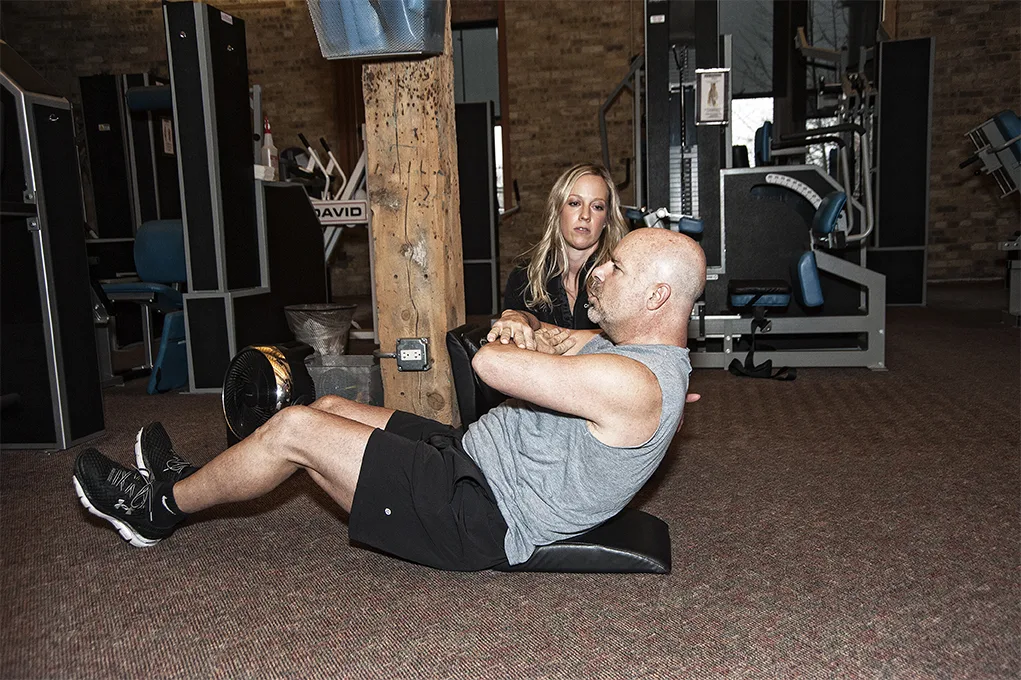
- Consider working with an expert, even if only for a few sessions.
In Chicagoland, the author’s trusted resources include CityWide SuperSlow (Lincoln Park), Marshall’s 584 (Lake Forest), and StrengthTime (Winnetka + Kenilworth).